A convincing city needs buildings that appear to want different things. A hotel wants visitors. A cultural venue wants an audience. A residential tower wants privacy, views, or at least the appearance of both.
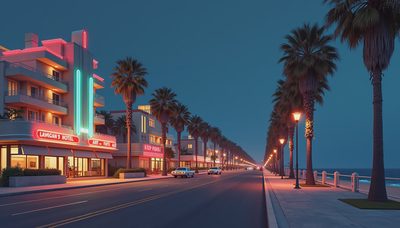
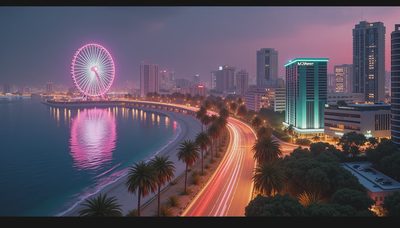
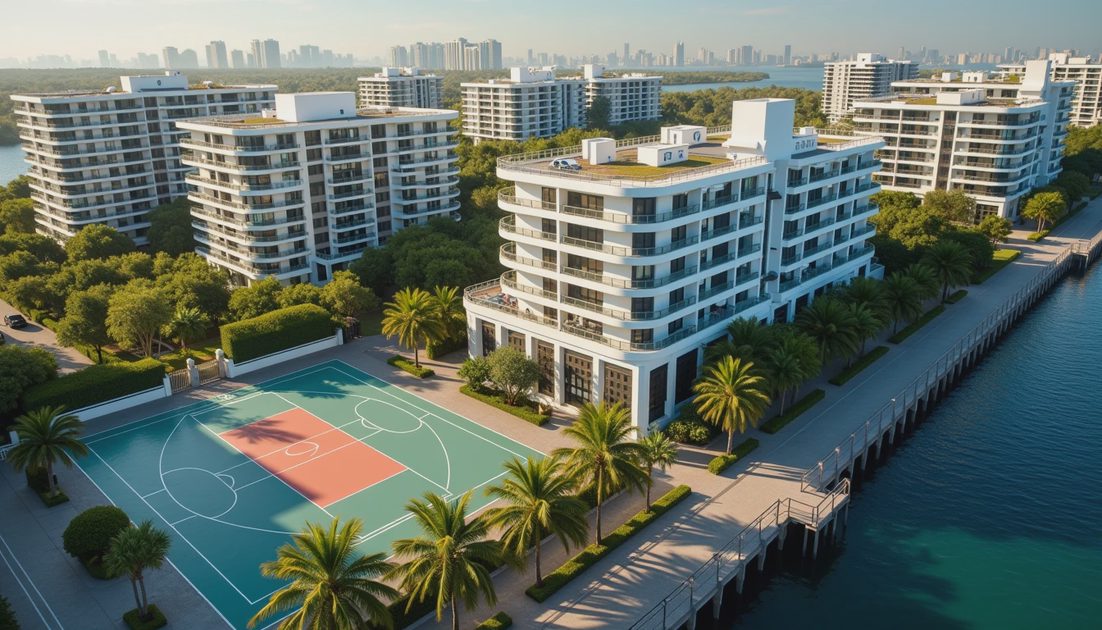
Rockstar’s official Vice City images place those ambitions close together. The daytime view around Hotel Valetta combines waterfront architecture, recreation space, traffic, and taller buildings. The nighttime Arts Center view rearranges the city around spectacle and illuminated public identity.
I find that mixture more revealing than a contest over polygon counts.
This article reads the published exteriors. It does not count enterable buildings or treat a visible storefront as confirmation of a shopping system.
ON THIS PAGE
A hotel belongs to a neighborhood
Low buildings make the towers work
What a storefront can establish
Public image after dark
FAQ
A hotel belongs to a neighborhood
The official image featuring Hotel Valetta does not isolate the hotel against an empty skyline.
Roads, palms, basketball courts, vehicles, terraces, and surrounding buildings remain visible. The hotel is one participant in a neighborhood rather than a decorative object waiting for a camera.
That context changes the reading.
The waterfront edge suggests leisure. Traffic introduces movement and work. Recreation space gives the district another use beyond tourism. Taller buildings extend the setting beyond the hotel’s immediate footprint.
The architectural variety matters too. Curved waterfront forms sit near more regular balcony grids. Broad white surfaces alternate with glass and darker recesses.
The eye can distinguish buildings without needing every business name to be readable.
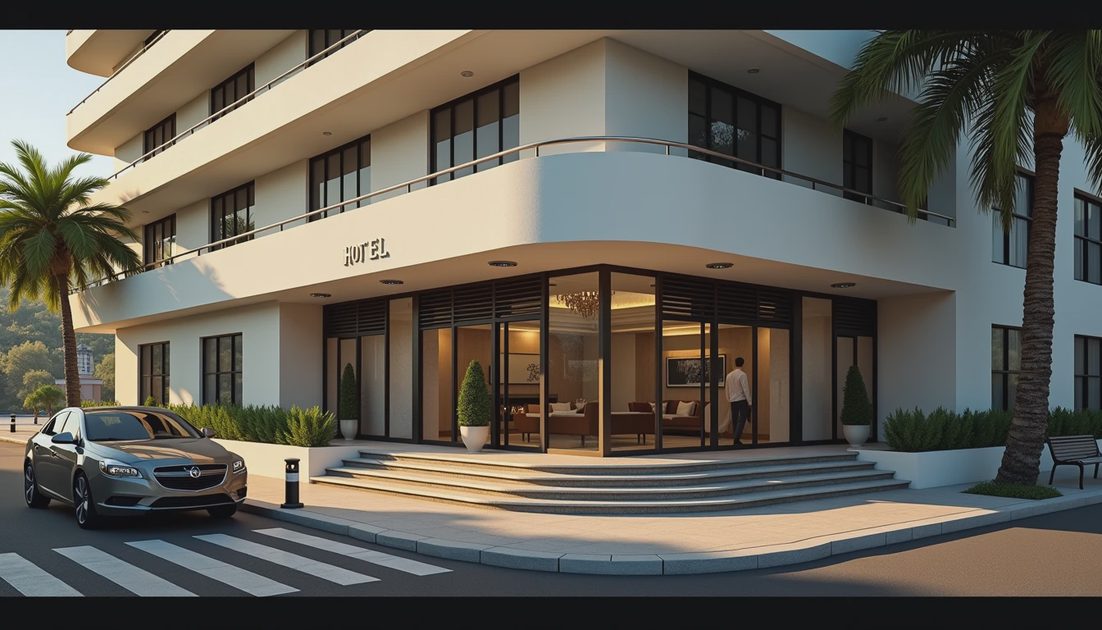
My favorite part of this composition is the amount of ordinary space around the more distinctive architecture.
Courts and road lanes prevent the view from becoming a collection of luxury facades with nothing happening between them. They suggest a district people move through and use.
The image does not establish ownership, room prices, accessible interiors, or a booking system. Its visible achievement is more immediate: leisure, circulation, and density belong to the same place.
Low buildings make the towers work
Tall buildings become easier to understand when the city preserves intermediate scales.
In the daytime view, lower waterfront structures and foreground activity give the more distant towers a relationship to everyday life.
Without that middle layer, a skyline can become an abstract wall.
Here, the road, hotel, courts, and palms provide several steps between a human figure and a high-rise.
Scale | Example in the image | Contribution |
|---|---|---|
Human | People using recreation space | A reference for size and activity |
Street | Vehicles, lanes, palms | Movement and neighborhood rhythm |
Building | Hotel terraces and balconies | A specific local identity |
Skyline | Taller structures beyond | Density and distance |
This is a compositional reading rather than a measurement. I am not calculating floor heights, traffic capacity, or exact distances from a promotional image.
It also explains why less distinctive buildings matter.
A plain block can give a memorable hotel room to stand out. If every facade behaves like a landmark, the city loses the contrast that makes landmarks useful.
For me, believable variety includes buildings that do not demand a second look.
What a storefront can establish
“Detailed storefronts” can refer to several different things: signs, display windows, recessed entrances, shutters, or the appearance of merchandise.
None automatically establishes that the player can shop inside.
That is where I would keep a firm editorial boundary.
An exterior is evidence of an exterior. A gameplay interaction needs evidence of an interaction.
A useful distinction has three levels:
Visible identity: a readable business or institutional name.
Architectural suggestion: a facade resembling a shop, hotel, or venue.
Confirmed function: an action explicitly shown or described.
The first two are worthwhile subjects for visual analysis. They can explain the city socially before functionality is established.
A named waterfront hotel communicates tourism more directly than an anonymous tower would. That interpretation remains useful even if the lobby never becomes a player destination.
A building can contribute to worldbuilding without becoming a mission entrance.
I think that is an overlooked strength of exterior design. The background is doing work even when it offers no button prompt.
It tells us what a district considers desirable, respectable, convenient, or expensive-looking.
Public image after dark
The official nighttime view around the Vice City Arts Center gives architecture another job: attracting attention through light.
The center’s broad, cool-lit surfaces differ from the warmer window grids nearby. A distant observation wheel supplies a simple landmark. Display panels and illuminated venue edges divide the foreground into smaller points of interest.
Buildings become public presentations.
They do not merely occupy space; their exteriors announce cultural importance, commercial confidence, or evening visibility.
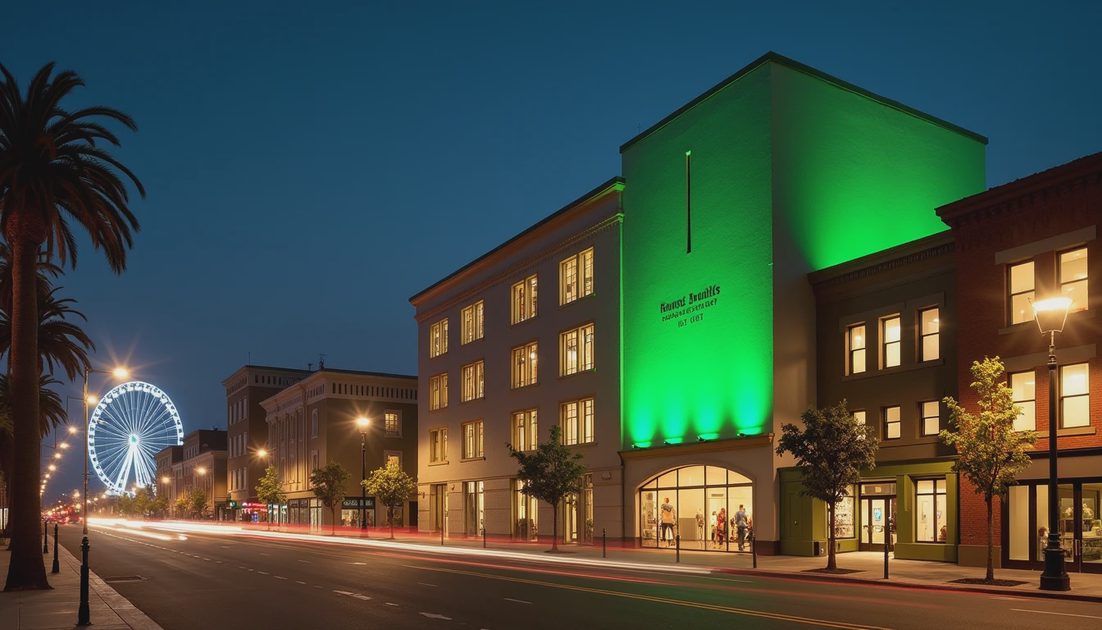
That is my interpretation of the visual hierarchy. It is not confirmation of a concert calendar, a theater activity, or an accessible exhibition.
An attractive cultural district can inspire expectations that a published exterior does not promise.
There is also a meaningful difference between daytime and nighttime identity.
Daylight emphasizes shape, materials, balconies, and gaps between structures. Night emphasizes occupied windows, signage, and illuminated edges.
A city can communicate through different features without changing its underlying architecture.
Start comparisons at street level
When comparing official city images, I would begin with the relationship between a building and the space around it.
Does its entrance appear to face a road, a pedestrian area, or the waterfront? Is the facade designed to be recognized from a distance? What ordinary activities surround it?
Those questions keep the analysis concrete.
They also prevent a common mistake: evaluating an entire city through its most dramatic skyline image.
A skyline can establish scale while concealing how the district works at ground level. Roads, courts, sidewalks, and lower structures provide a different kind of information.
The Valetta view is especially useful because several of those layers appear together.
My interest is not simply whether the hotel looks impressive. It is whether the surrounding space makes the hotel seem to belong there.
That is where the image becomes more than architectural display.
What remains an open question
The published views support a discussion of architectural variety and urban presentation.
They do not settle interior coverage, business interaction, population persistence, or the complete relationship between districts.
Those questions should remain open rather than being filled with assumptions.
The good news is that exterior analysis does not need those assumptions to become interesting.
A hotel can suggest tourism. A cultural building can project public prestige. A court can introduce a neighborhood use that differs from both.
The city becomes readable through the coexistence of those identities.
FAQ
Are the visible hotels confirmed player properties?
No. An exterior and a business name do not establish ownership, room access, or a property system.
Do dense city images prove equally dense gameplay everywhere?
No. They show particular compositions. Playable boundaries, accessible routes, and activity distribution need additional evidence.
Why analyze buildings that may remain background scenery?
Because their appearance helps explain the setting.
Tourism, housing, culture, and commerce can be communicated through architecture before a mission begins.
The useful question is not only how many doors might open. It is what the city tells us while we are still outside.
There’s always a story on the next block.