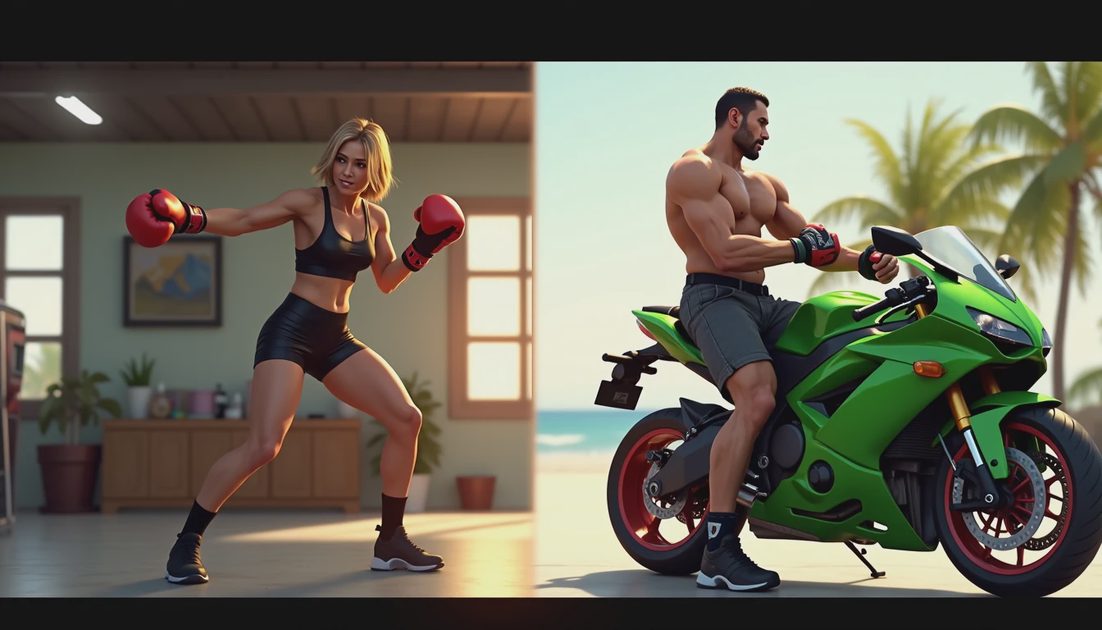
Lucia is throwing a punch. Jason is positioned beside a motorcycle.
Those two official images introduce their subjects through action and context before a viewer needs a biography.
The contrast is useful. Lucia’s gym image compresses attention around effort, expression, and an extended arm. Jason’s low-angle motorcycle image spreads attention across a person, a machine, palms, and bright sky.
One feels immediate. The other feels like a presentation of presence.
That is a visual reading of Rockstar’s published character images. Clothing and posture can shape an introduction, but they cannot establish a skill tree, a complete personality, or the outcome of a relationship.
ON THIS PAGE
Lucia: effort before explanation
Jason: a low-angle introduction
What clothing actually tells us
Reading the portraits together
FAQ
Lucia: effort before explanation
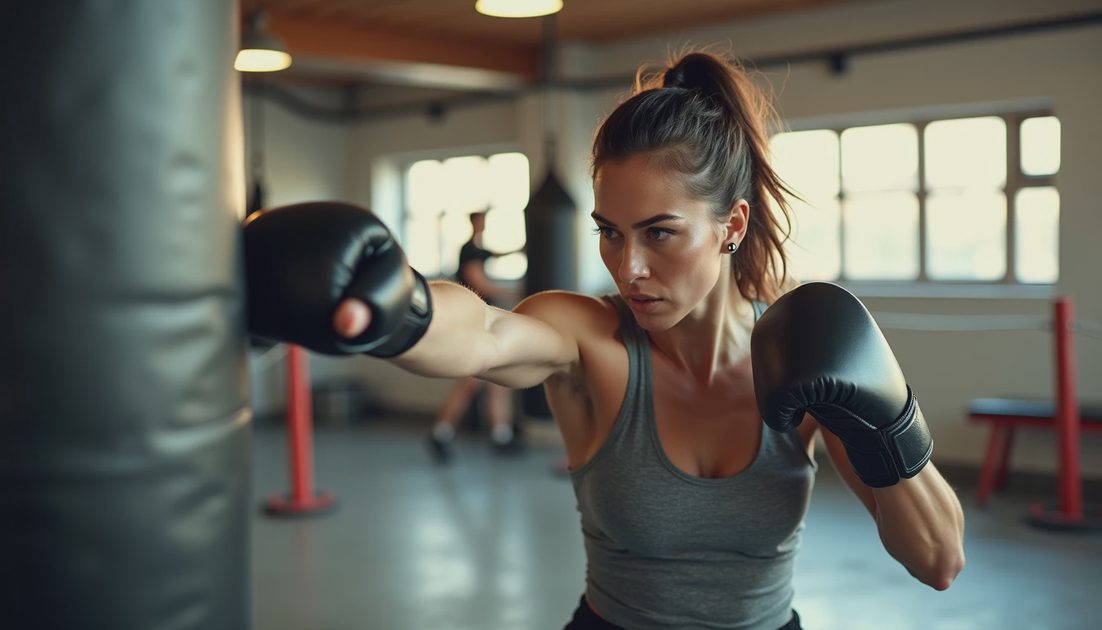
The official gym image places Lucia close to the camera, with one arm extended and the other hand raised.
Her hand wraps, gray training top, and earbud locate the action in a recognizable exercise setting. Equipment and another figure remain less distinct behind her.
Her expression matters as much as the clothing. The tense mouth and focused gaze make the effort visible.
The extended arm also creates depth. Rather than offering a flat portrait, the composition gives the viewer a direction to follow across the frame.
I read this as an introduction through physical concentration.
Lucia is doing something demanding. The image does not ask a costume or facial expression to carry the whole introduction on its own.
What I would not infer is a confirmed boxing minigame.
A character training in promotional imagery does not establish repeatable practice, an activity menu, or measurable combat progression.
The useful observation is already substantial: Rockstar chose a moment in which exertion appears in posture, expression, and surrounding context.
That makes the character feel occupied rather than merely displayed.
Jason: a low-angle introduction
Jason’s motorcycle image creates a different relationship between character and camera.
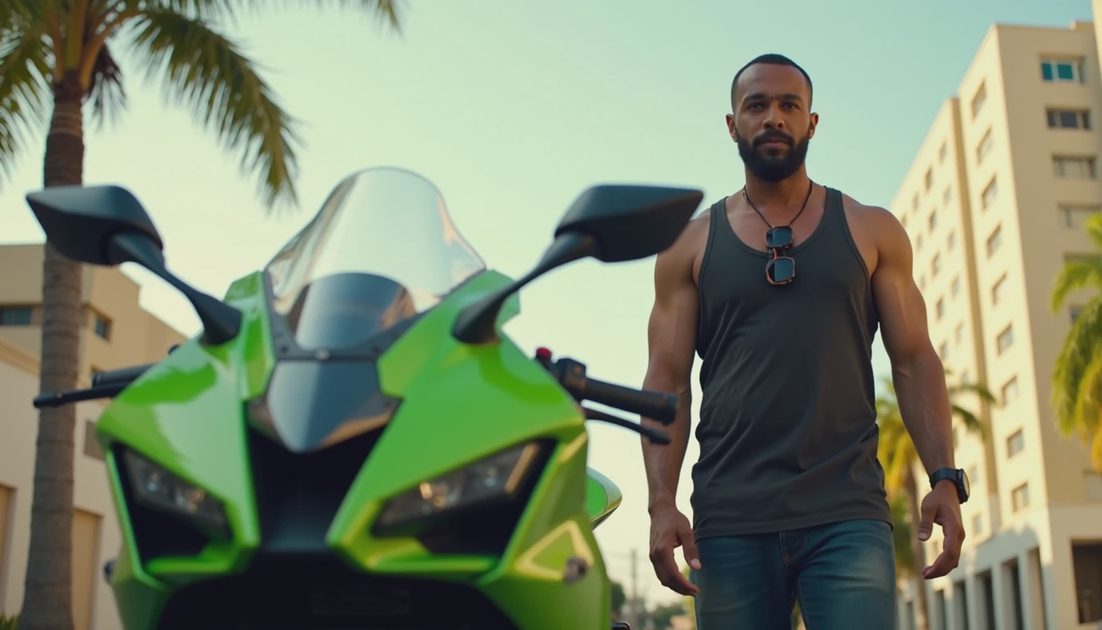
A green sport motorcycle occupies much of the foreground. The viewpoint looks upward toward Jason, who wears a dark sleeveless top with sunglasses hanging at the neckline.
Palms and bright sky establish an open-air setting. Strong light separates the person and machine from the background.
A firearm is visible beside his leg. It introduces danger without showing an active confrontation.
The motorcycle matters before a viewer identifies its brand or model. Its angular front bodywork creates a large foreground shape, while Jason’s more vertical figure rises behind it.
Person and machine become a combined introduction.
My first impression is controlled display rather than movement.
The image presents someone to look at. Lucia’s training frame directs attention toward an action already underway.
That does not prove Jason is emotionally calm or Lucia is impulsive. A selected pose is a selected moment, not a complete psychological profile.
Clothing belongs to a situation
Clothing becomes useful evidence when the interpretation stays close to what is visible.
A training top and hand wraps fit physical exercise. A sleeveless outfit in strong daylight fits the heat suggested by the setting.
The problems begin when recognizable wardrobe becomes a personality diagnosis.
Visible detail | Grounded reading | Unsupported leap |
|---|---|---|
Hand wraps inside a gym | A depicted training situation | A boxing progression system |
Earbud | A contemporary everyday accessory | A complete player-controlled music feature |
Sunglasses at a neckline | A styling choice within the setting | A fixed personality trait |
Firearm beside a leg | Danger is part of the portrait | A demonstrated combat system |
I find practical details more interesting than broad labels such as “tough” or “cool.”
Where an accessory sits, how fabric follows an arm, and what a hand is doing can make a person feel situated in a particular moment.
Those details also prevent the characters from reading like interchangeable models wearing different textures.
Clothing works together with posture, environment, and camera placement. Remove those relationships and much of the meaning disappears.
The camera changes perceived presence
The difference between these images is not simply that one character trains while another stands beside a vehicle.
The camera gives those actions different weight.
Lucia’s proximity makes effort feel immediate. Jason’s low-angle framing gives the combined figure and motorcycle greater visual presence.
Neither effect requires a claim about final gameplay cameras.
A promotional viewpoint can shape an introduction without becoming a selectable player perspective.
What a character is doing and how the camera presents it are separate decisions. The image becomes interesting where those decisions meet.
That is why I would hesitate to describe character design using clothing alone. The same outfit can produce a very different impression in a close action frame and a low-angle portrait.
Read the two portraits together
The strongest comparison concerns presentation.
Lucia’s frame uses bodily effort to hold attention. Jason’s uses camera angle, vehicle scale, and open space.
Those approaches create distinct first impressions without requiring opposite personalities.
Both images still belong to the same broad visual world: contemporary clothing, tangible surfaces, environmental context, and visible associations with risk.
There is a temptation to treat every promotional pairing as a complete statement about the protagonists’ relationship.
I would stop earlier.
These images show how two people are being introduced visually. They do not establish every balance of control, loyalty, attraction, or conflict between them.
A useful second pass is to read the silhouettes before the faces.
Lucia’s arm describes an action. Jason and the motorcycle form a larger combined shape. The compositions remain different even before fine facial detail returns.
That makes them readable at more than one level of attention.
A practical way to read the next image
When another official character image appears, I would begin with three questions:
What is the body doing? Describe the action before assigning a mood.
What does the setting contribute? A gym and an open roadside perform different jobs.
What remains outside the frame? Avoid supplying a history that the image has not shown.
Then separate observation from response.
“The camera looks upward” is an observation. “The pose feels imposing to me” is a response.
Both belong in criticism when the writing makes the distinction clear.
That leaves room for personal interpretation without turning an impression into an official character fact.
FAQ
Do these images confirm playable exercise activities?
No. They show depicted situations. Repeatable gameplay features require separate confirmation.
Can clothing establish a protagonist’s personality?
It can guide a first impression.
Dialogue, choices, relationships, and narrative context are necessary for a fuller reading.
Why discuss camera angles in a character-design article?
Because presentation changes perceived presence.
A close action image and a low-angle portrait can give different meanings to otherwise ordinary clothes and accessories.
I would keep these first impressions provisional. A good introduction gives us something specific to notice while leaving the story room to complicate it.
There’s always a story on the next block.