
Niko reaches Liberty City with a destination, a cousin, and an account of America that reality immediately begins to challenge.
GTA IV makes that disappointment concrete. Roman’s promises meet an unimpressive apartment. The cousin who appears to offer a foothold also brings financial trouble and obligations. The city becomes real through errands before it becomes a complete personal map.
This article reads The Cousins Bellic, It’s Your Call, and Three’s a Crowd. Spoilers stop within those early missions. Later revelations are deliberately excluded.
What stays with me is how modest the opening tasks are. Driving someone, waiting outside, answering a phone, and collecting passengers become the first terms of Niko’s relationship with his new home.
ON THIS PAGE
Arrival meets the apartment
Roman is a connection and an obligation
A phone makes trouble portable
The city through ordinary errands
FAQ
Arrival meets the apartment
The Cousins Bellic brings Niko from the cargo ship Platypus into Roman’s version of Liberty City. The contrast between the cousin’s earlier claims and his actual living conditions appears quickly.
The apartment matters because it turns an abstract disappointment into a place. A promise can remain vague until somebody has to sleep inside its consequences.
This is a stronger opening choice than explaining the city’s entire economy in dialogue. The player can understand the mismatch through scale, condition, and the smallness of what has actually been secured.
I read the apartment as the first revision of Niko’s expectations. It does not mean the whole city is already understood. It means his most immediate source of reassurance has become less reliable.

There is also affection inside the disappointment. Roman is not merely a false advertisement with a face. He is family, which makes the gap between promise and reality harder to dismiss cleanly.
Roman is a connection and an obligation
A newcomer needs someone who can provide a first address, a local vocabulary, and a reason to move through unfamiliar streets. Roman performs that role.
But the connection is not free of consequences. His circumstances also give Niko problems to inherit. Help and burden arrive through the same person.
That mixture makes the relationship more useful than a simple contrast between an honest newcomer and a dishonest cousin. Roman’s optimism can be generous, evasive, and self-protective at the same time.
The opening therefore makes dependence emotionally complicated. Niko can recognize the exaggerations while still needing the relationship that carried them.
Opening element | Practical role | Narrative effect, in my reading |
|---|---|---|
Roman’s apartment | First foothold | Shrinks the promised dream to a real address |
Roman’s car and errands | Means of movement | Makes family dependence part of navigation |
Loan-shark trouble | Immediate danger | Reveals costs hidden by optimism |
Passenger collection | Ordinary social task | Expands the city through relationships |
I find that structure persuasive because arrival rarely begins with a complete independent life. It begins with arrangements made through other people.
A phone makes trouble portable
In It’s Your Call, Niko drives Roman to a gambling location and watches for loan sharks. The phone becomes part of the task: attention and warning matter as much as simply reaching a marker.
The device is a tutorial tool, but it also gives the opening a social logic. Someone can contact Niko, ask for something, and turn a moment of waiting into a new responsibility.
That is my favorite kind of tutorial integration. The interface does not need a separate fictional excuse because the relationship already supplies one.
I would not overstate the scene as a grand theory of connected life. Its immediate effect is enough: Roman’s trouble can reach Niko at a distance, and Niko is expected to respond.
The city stops being a collection of destinations and becomes a network of requests.
Waiting is part of the story
The lookout assignment gives Niko an unusual first relationship to urban space. He is not only traveling through it. He is watching for a threat that might appear within it.
That changes how a street reads. Passing people and approaching vehicles become potential information rather than scenery.
The task also clarifies the cousins’ positions. Roman takes the risk associated with gambling; Niko is recruited to manage the consequences around it.
My interpretation is that the opening makes obligation visible through divided attention. The player must think about an environment while also tracking someone else’s needs.
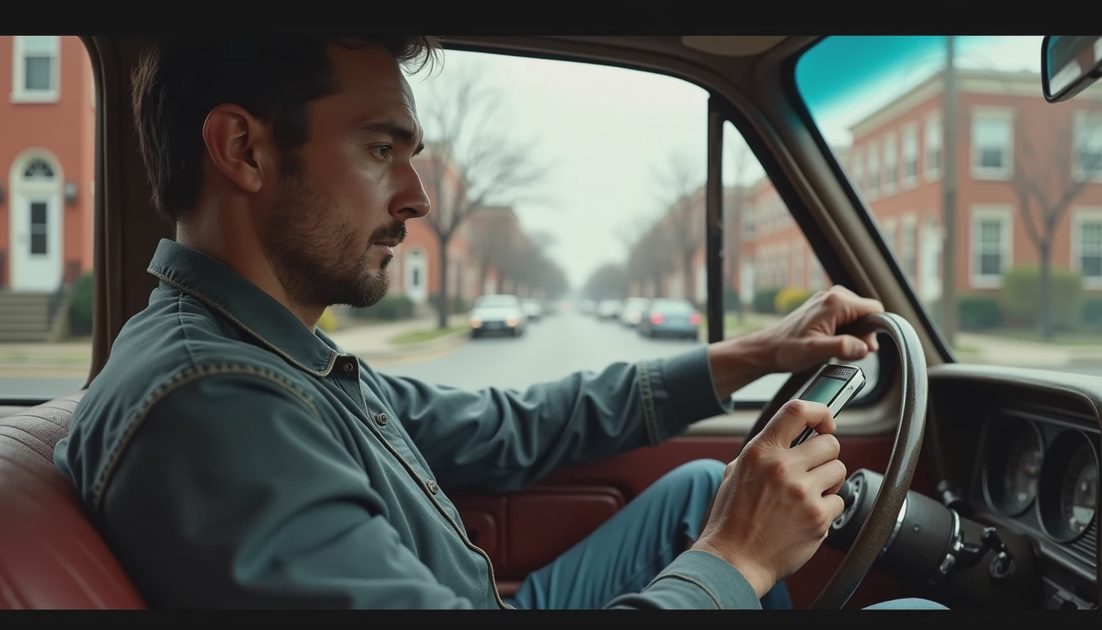
That is a useful contrast with the grandeur of an arrival sequence. Liberty City’s scale may be impressive, but Niko’s immediate concern is whether his cousin’s latest arrangement is about to go wrong.
The city through ordinary errands
Three’s a Crowd expands the social setting by having Niko collect Mallorie and Michelle and drive them to an apartment. Clothing also enters the opening’s sequence of introductions.
Those activities are ordinary, which is precisely their value. A new city becomes familiar through repeated small journeys and the people who give those journeys a purpose.
It is easy to summarize such missions as “just driving.” That misses the way routes acquire associations. A pickup location becomes connected with particular people; an apartment becomes more than an anonymous exterior.
I prefer to read this as the construction of a first social map. The player learns not only where things are but whom a place matters to.
No later revelation is needed for that early effect to work. The opening can be analyzed on the information available at the time.
A dream reduced to workable tasks
These missions repeatedly bring large expectations down to manageable actions: reach an apartment, drive a cousin, watch a street, answer a call, collect passengers.
That reduction does not make the story small. It gives the disappointment a practical form. Niko cannot solve Liberty City in one decision, but he can complete the next request.
When revisiting the opening, I would watch for three shifts:
A promise becoming a physical location.
Family affection becoming an obligation.
An unfamiliar street becoming associated with a person.
Those shifts explain how the city begins to feel personal before its larger conflicts have fully emerged.
FAQ
Does this reading include later character revelations?
No. It stays within the three opening missions named above.
Is Roman only a joke about failed success?
That is too limited. He is also Niko’s first connection to shelter, movement, and a social network.
Why focus on ordinary driving tasks?
Because they give the city personal meaning. Routes become connected to dependence, friendship, and responsibility.
Liberty City begins as an idea Niko has been sold. The opening turns it into places he must reach and people he must answer.
There’s always a story on the next block.